Reading, taken seriously.

Where the reading happens.

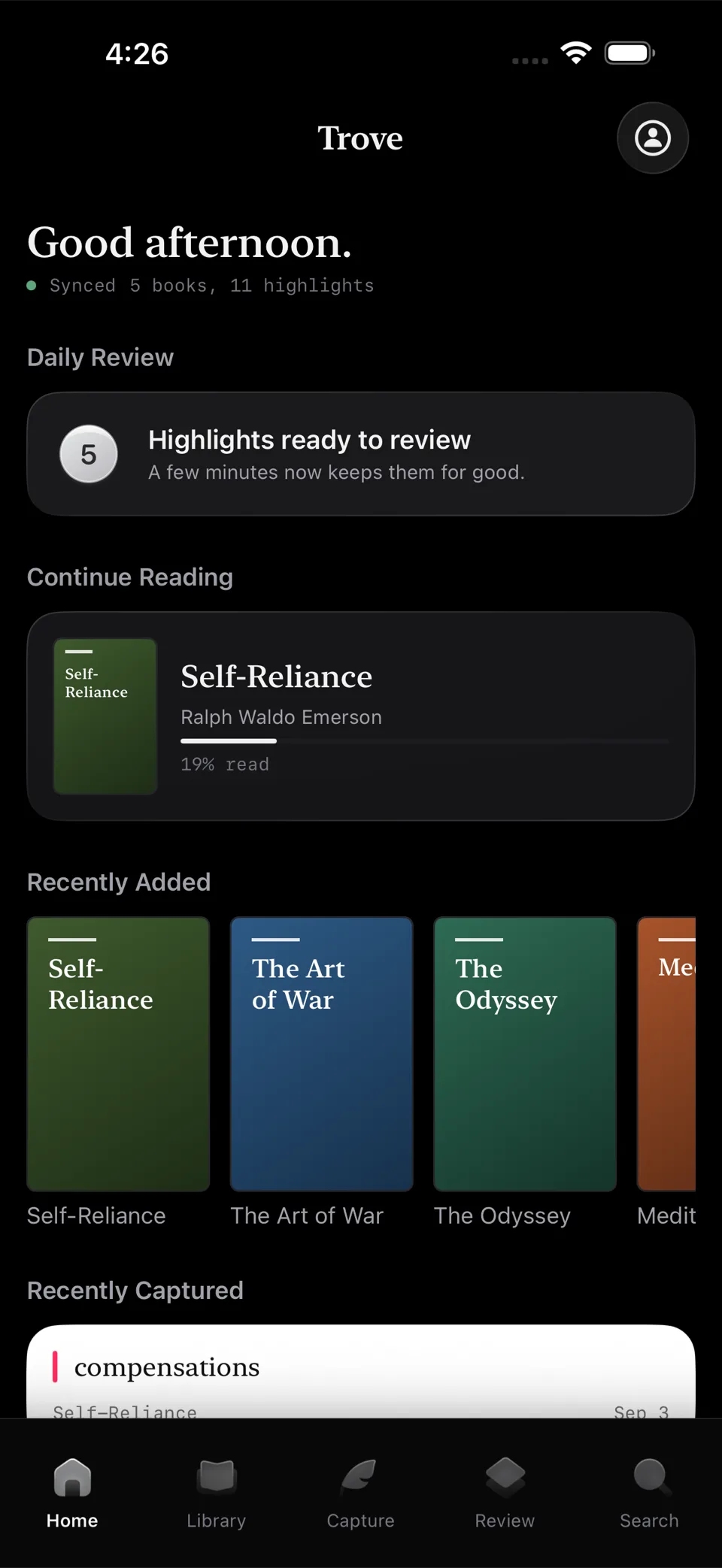
The Trove home screen: a greeting, five books synced with eleven highlights, a daily review card offering five highlights to revisit, and Self-Reliance nineteen percent read.
Home. What is due, what you were reading, and what you marked recently. No feed, no recommendations, nothing to scroll past.
Bookshop. Discover a book, read a sample, and make it yours. An illustrative purchase concept; the edition, price and checkout are not a live offer.
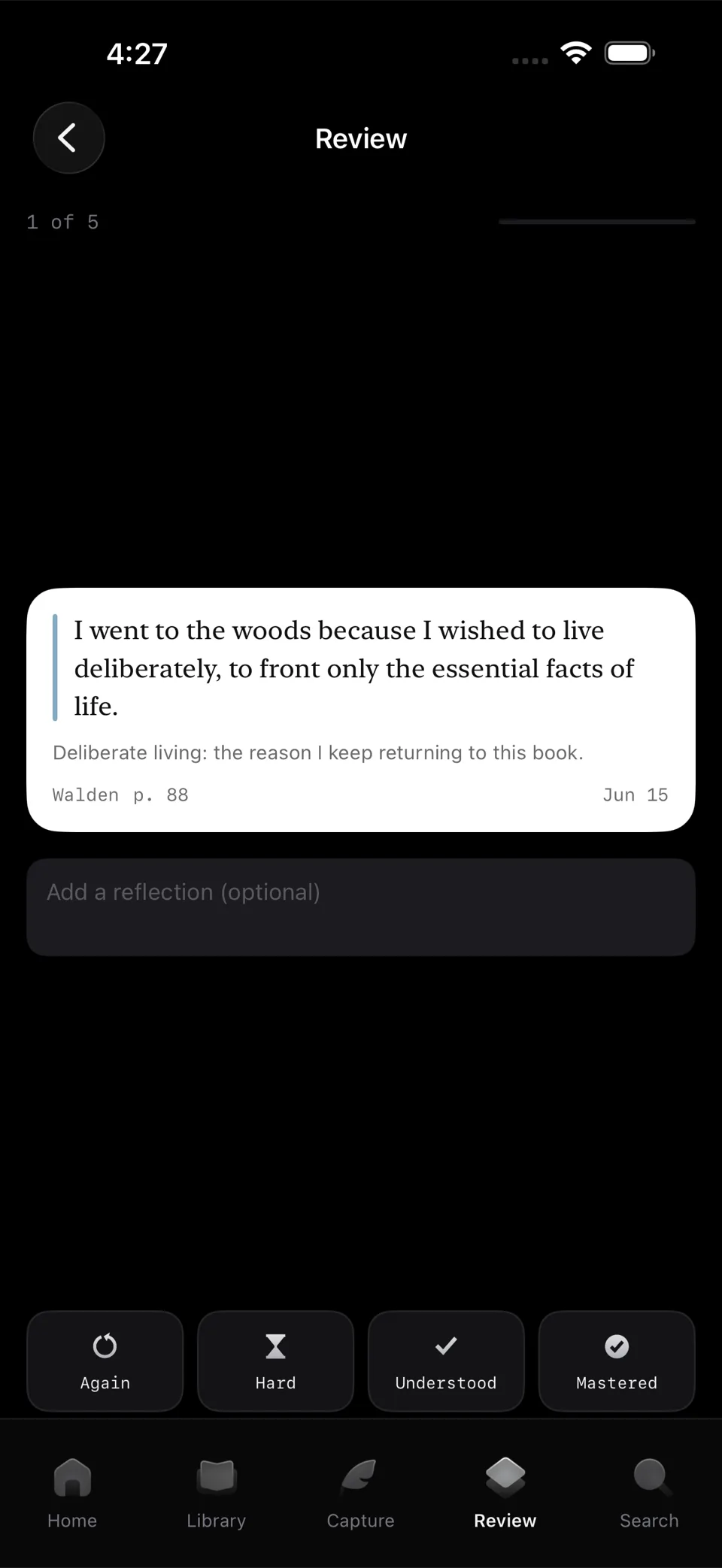
A Trove review card: a passage from Meditations page 71 on a white card with the note left on it, a reflection typed underneath, and four grading buttons reading Again, Hard, Understood and Mastered.
Review. A highlight comes back on a white card with the note you left on it, and you say how well it landed. The reader itself stays warm paper: the dark shell never touches the page you are reading.

Reading, library, capture and review are built. The marketplace, the author studio and the schools dashboard follow.

A private library, not a dashboard.

Highlights anchor to the exact words rather than a rough position in a file, so they survive a re-flow, a font change and a new edition. Everything you mark stays yours to export, and reading stays private: authors see aggregates, never a person.

Everyone sells books. Nobody has made reading them any better in fifteen years.

The big stores treat a book as a SKU. The reading apps attached to them are storage: a file, a font menu, a percentage. Meanwhile the marketplaces that will publish anything have filled themselves with unlicensed editions and machine-written filler, so a reader can no longer trust that a shelf means anything, and a serious author is one listing among a million.

Nobody owns both ends. The stores do not care how the book reads, and the reading tools do not sell books, so neither side can fix what the other one broke.

Three surfaces, one platform

Built so that owning all of them compounds.

A reader people prefer

Books bought and read in the same place, on a warm paper surface built for long sittings. Review brings a reader back to what they marked, and nothing is locked in.

A studio, not a listing

Write or upload, edit, analyze, and sell into a curated shelf where being accepted means something. Because we own the reading app, an author can learn where readers slowed down, stopped or reread.

Licensing that fits a class

Seats that provision straight from a roster, assessment with integrity built into the device instead of surveillance, and no AI detector ever pointed at a child’s writing.

The reading surface

Three themes, one page. Warm paper, a terminal view in monospace, and a dark theme, each with its own highlight color.

A field remembers being walked across, but it does not remember who did the walking.

The Long Field · p. 148

Anchored to the words. A highlight points at the sentence, not at a byte offset, so it survives a re-flow or a new edition.

Real book faces, not a font menu.

Reading TypeThemeLayout The Long Field

Chapter Four

He had walked the field twice before the light came up properly, and both times the grass had told him nothing at all.

A class, not a license spreadsheet.

Northfield Academy English 11English 9History 10 128 of 140 seats
Assigned3titles
Submitted96+18 today
Graded7174% of submitted
Grading progress 25 left · 2 flagged for a second read
StudentTitleReadTestGrade
A. WhitfieldSeat 04The Long Field SubmittedA−
M. OseiSeat 11The Long Field In progress-
R. DelacroixSeat 17Salt and Iron SubmittedB+
T. NakamuraSeat 23The Long Field Not started-

Integrity is enforced by the device during the test. Nothing is recorded about the student outside it.

Where readers actually slowed down.

Author studio AttentionSalesHighlights The Long Field
Copies sold1,284+38 this week
Reading now213across 19 countries
Finished61%above category
Highlights4,9021,110 on one line

Readers still reading, by chapter

Chapter 5 is where you lose them. Attention falls 34 points across eleven pages, then never recovers. That is a fixable problem, and it is invisible on every other platform.

Curation is the product

Trove is not an open upload pipe, and it never becomes one. Nothing reaches the shelf that the uploader does not own, nothing unlawful, no unauthorized editions, and no machine-written filler.

That is a cost, and it is the moat. Every competitor that chose scale over standards is now permanently unable to promise a reader that the catalog is worth their time. We can, and we intend to keep being able to.

Where it stands

  • BuiltThe foundation and the reading experience, which is the part everything else depends on.
  • NextThe commercial spine: catalog, checkout, and the author payout ledger.
  • ThenThe author studio and the schools dashboard as full web surfaces.
  • LaterPhysical books, and a verified print purchase that unlocks the same reading tools on paper.

Be told when Trove opens.

One message, on the day Trove opens. Nothing else. Your address is held in our email only, not in a mailing list or any database, and you can ask us to delete it at any time through the contact form.